
3D NAND
The profile control problem gets harder with every generation
- 200 Layers
- 300 Layers
- 500+ Layers
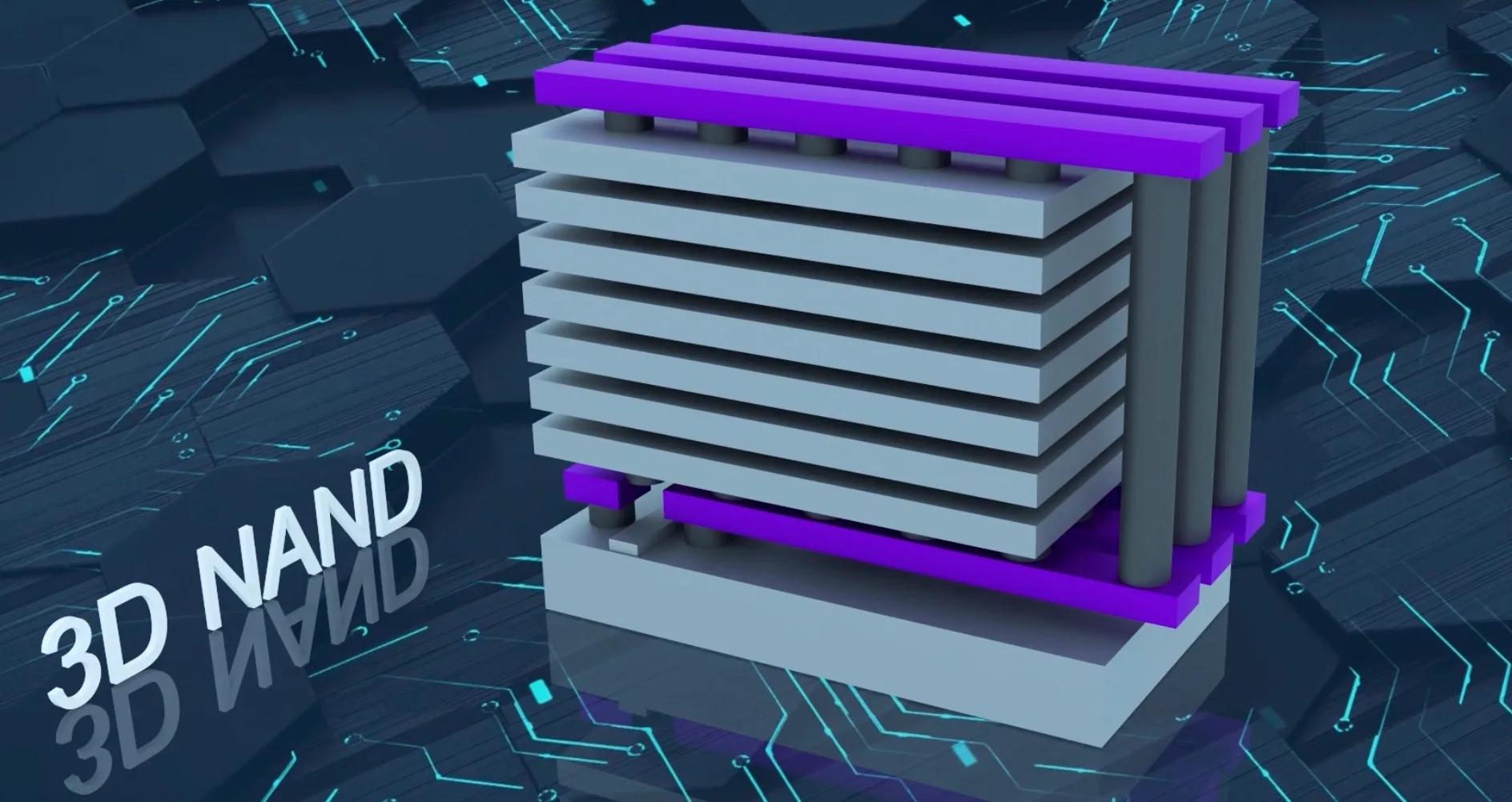
The yield challenge scales with the stack.
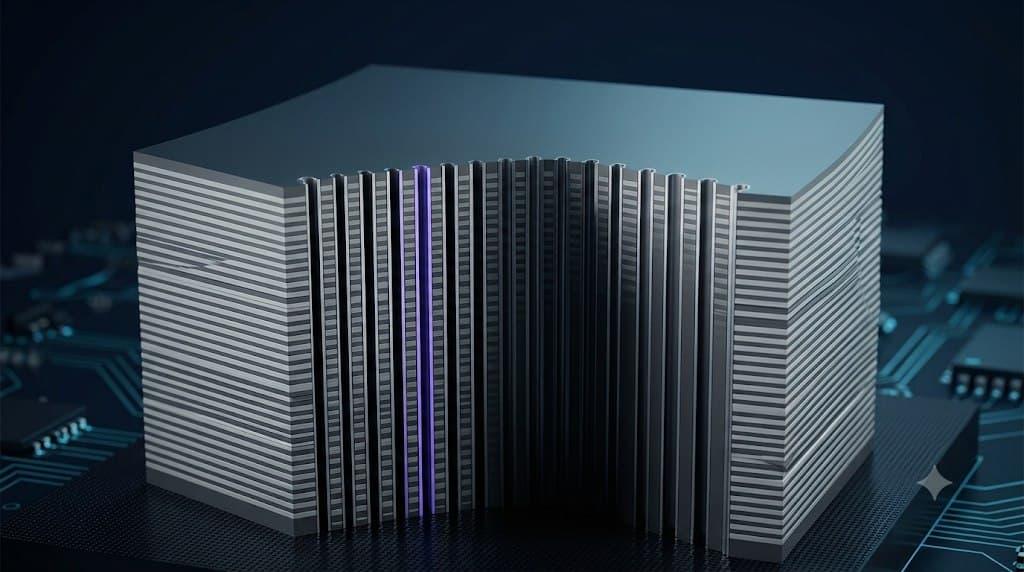
As 3D NAND stacks grow taller, the aspect ratios inside those structures reach dimensions where conventional etch loses control of profile, uniformity, and surface quality. ALE is the precision finishing tool that protects yield as layer counts climb.
Where AAT Fits
The primary etching in 3D NAND — drilling the channel holes, cutting the slit trenches — is done by high-power RIE systems. That is not changing. But as stacks move past 200, 300, and eventually 500+ layers, the damage left on channel hole sidewalls, the non-uniformity at staircase etch steps, and the profile variation in wordline recesses all become yield-limiting problems that RIE alone cannot fix.
ALE addresses these problems. It removes damage inside high-aspect-ratio structures, performs selective recess of specific layers, and cleans up profile non-uniformity — without enlarging the critical dimensions that RIE already established.
- 01Sidewall damage removalInside high-aspect-ratio structures
- 02Selective layer recessSpecific layers — e.g. wordline recess
- 03Staircase profile cleanupNon-uniformity at staircase etch steps
- 04Dimension-preserving finishWithout enlarging RIE-set critical dimensions
The materials transition from tungsten to molybdenum wordlines — driven by the resistivity advantages of Mo at thin film dimensions — introduces new ALE requirements at the gate recess step. AAT's AI optimizer adapts process parameters automatically as chemistry and material targets change, reducing the qualification time that new material transitions typically demand.
Demonstrated Performance
AAT is not a replacement for your RIE infrastructure. It is the precision tool that handles the steps RIE cannot – deployed at specific points in the process flow where atomic-scale control determines whether the wafer yields or not.
- Synergy Factor>90%
- Linearity (R²)>0.9997
- Cycle Time~2 seconds
- Synergy Factor>80%
- Linearity (R²)>0.9947
- Cycle Time~2 seconds
Both modes operate in the same chamber. High throughput mode for bulk selective recess; precision mode for damage removal and critical dimension control.
Source: SPIE Advanced Lithography + Patterning 2026, Paper 13984-24
The AAT Advantage
Two modes, one chamber.
A high throughput mode at >90 Å/cycle for selective recess and high precision mode at ~2 Å/cycle for surface finishing and damage removal. Switched algorithmically based on process requirements — no chamber swap, no tool changeover, no manual recipe intervention.
Cycle times that do not kill throughput.
At ~2 seconds per cycle, AAT delivers atomic-scale precision at production-worthy throughput.
Self-limiting by design.
Synergy factors exceeding 90% in throughput mode and 80% in precision mode mean the etch stops when the surface is clean — not when the timer runs out. The AI control loop monitors this in real time, maintaining consistent results wafer to wafer and lot to lot without operator adjustment.